Video 1. Pinnularia sp. on the water Surface
(150x time lapse)
Video 2. Pinnularia sp. on a substrate
(150x time lapse)
Pinnularia sp. on the water surface
When Pinnularia cultures are prepared, a fast sedimentation of inserted diatoms is usually observed. An exception among my cultures was Pinnularia gentilis (Donkin) Cleve from a small pond in Hohenheim (Stuttgart, 48°42'32.2"N 9°12'40.3"E). At the time of observation, the diatoms were already in culture for 6 months and had a typical length of 200 µm. This is such a Pinnularia in valve view:
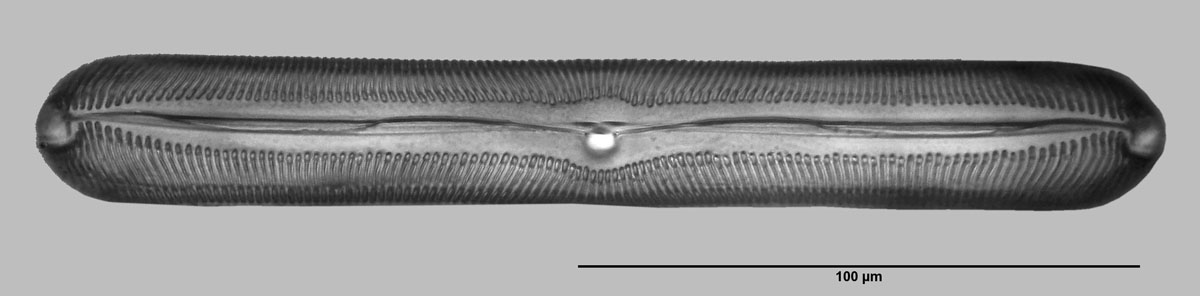
In the case of diatoms from these cultures, it was striking that many diatoms were swirled up and sedimented relatively slowly on the substrate when the petri dish was carried to the microscope. If one observes the surface of the water immediately after swirling up the diatoms, one regularly finds Pinnularia, which float on the surface of the water. In a densely populated petri dish with a diameter of 55 mm, the water surface contains a few to several - tens of diatoms. Diatoms often float in groups on the water.
The first video (Video 1, time lapse factor 150) at the top shows Pinnularia on the water surface and afterwards diatoms moving at the bottom of the petri dish. By chance, all diatoms are located on the surface of the water in a valve view (valve is uppermost). Video 2 also shows diatoms floating on the water's surface in the girdle band view. Some observations will be described below.
The sinking of the diatoms
Already in the first minutes many of the diatoms sink to the ground. Others remain on the surface for hours and only a few for days. The videos shown here were taken immediately after the swirling up of the diatoms. Therefore, the sinking of diatoms to the bottom can often be observed.
In all observed cases, the diatom starts to sink with the diatom taking a position perpendicular to the water surface. Often it remains on the water surface in this orientation for a while. The diatom often sinks to the ground in this orientation. However, it is not unusual for the diatom to rotate around the transapical axis or pervalvarous axis as it sinks. It is not possible to identify which axis it is because the automatic image series focused on the diatoms on the water surface. It is also not clear whether the direction of rotation changes.
In the two videos above, the sinking with and without rotation is recorded. For better visibility, an extracted clip from Video 1 (90x time-lapse) is shown below (Video 3). In this video, you can observe diatoms rotating twice as they sink. Please note that there are other special details in the video. The diatom in the upper right-hand corner, which later sinks down under rotational movements, is temporarily in a vertical position, but returns to the surface in a horizontal orientation "without external help". This cannot be explained without active movement in the resting water body, because the potential energy of the diatom in the floating state with horizontal alignment is higher. For a longer period of time another diatom hangs vertically on the water surface. Later it is transported to a horizontal orientation after collision and floats on the water surface. Apparently, it is not alive anymore. The Video 4 shows two cases of sinking diatoms (30x time-lapse) with no rotation. The sequences are separated by a short dark pause.
Video 3. Sinking diatoms (30x time-lapse) exhibiting rotation
Video 4. Sinking diatoms (30x time-lapse footage) that do not exhibit any rotation
Movement patterns
Video 1 and Video 2 shown above already give a good impression of the typical movement patterns. As on substrate, Pinnularia in valve view have a high mobility and cover longer distances, while back and forth movements are carried out in girdle view position. Such long distances are not covered by Nitzschia sigmoidea at the water surface. The question arises which way this is accomplished with a raphe that is below the surface of the water. To my regret, I cannot give a satisfactory explanation.
Furthermore, Video 2 at the top right shows a Pinnularia, which rotates around its apical axis and thus reaches the valve view from the girdle view. So it can cover a wide curve before sinking. Here, as in other sequences, these approximately circular paths are typical. The trajectory is distorted by a more or less pronounced drift movement. As in the case of the movement on substrate, I suspect that the EPS transport in the area of the helictoglossa is the cause of rotation about the apical axis and the curvature of the path.
Video 5.
Video 5 shows three differernt movement patterns. They are detail enlargements from a larger image format. The first Pinnularia describes a typical roughly circular orbit, which is distorted by additional drifting motion, the second one a rotation around the pervalvarous axis almost without forward motion and the third one finally a wagging motion, thus a change of the direction of rotation in quick succession. After each video sequence an image of the superposition of the frames is inserted.
Interaction between diatoms
Collisions of diatoms on the water surface are frequently observed. As the videos shown so far show, they are mostly unspectacular and differ little from collisions on the substrate. Within a few hours of observation I could observe and record one exception. The following Video 6 shows the "dance" of two Pinnularia in 60-x time-lapse.
Video 6.
There is an obvious long-distance interaction. The cause is not recognizable. Since this interaction is apparently only rarely observable, it seems plausible to assume an interaction via non-visible adhesive EPS flakes. Hydrophobic or hydrophilic areas at the diatoms are also plausible, analogous to the hydrophobic properties of Nitzschia sigmoidea. Water motion could also play a role.
In the absence of a sufficiently strong, systematic and attractive interaction, pattern formation as in Nitzschia sigmoidea does not occur.
Summary
While some aspects of the movement of Pinnularia on a water surface can be explained, many aspects seem to require further explanation. It should be noted that there were only small concentrations of bacteria on the water surface. They never formed a continuous film at any time.
At least in cultures, diatoms on the water surface are not uncommon. I was also able to observe floating diatoms of the genera Cymbella and Rhopalodia. The latter moved like Pinnularia in large circles. Therefore, anyone who cultivates diatoms in petri dishes is recommended to have an occasional look at the water surface.