Biofilm with gas bubbles (oxygen), which becomes detached from the bottom of the petri dish. This biofilm consists of diatoms and mucilage extruded by the diatoms.
Nutrient solution
Diatoms can be cultivated in water or on agar. Agar is often used for the raw culture, because the diatoms which have reproduced on it can easily be isolated. For unknown reasons, we had little success in cultivating diatoms on agar. For experiments on diatoms in culture vessels, water is preferable, because mechanical devices can be used for experiments in the culture vessel and the environment is more natural. In particular, there is no additional reduction in the mobility of the diatoms in water.
In cultivation, diatoms are transferred into a suitable nutrient solution. Apart from water, this medium typically consists of various salts, vitamins, trace elements, phosphate, nitrate and silicate. Marine salt is to be added in case of marine diatoms. Often in recipes soil extract is included, which in my opinion is also a indication that the ideal ingredients are not exactly known.
Procurement
One can produce nutrient solutions according to classical or modern recipes by themselves. A variety of recipes for algae in general and diatoms in particular for both freshwater and seawater can be found in "Algal Culturing Techniques" (Robert A. Andersen [Editor], Academic Press). In many cases, it is possible to buy ready-made nutrient solutions from retailers. They are obtained as a medium ready to be used or in the form of a highly concentrated solution or powder.
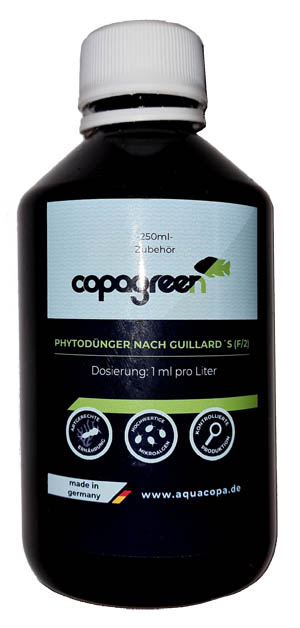 We didn't bother looking for culture media for diatoms that are difficult to cultivate, particularly since most species from local waters could be cultivated using “standard” nutrient solutions. In the original version of this page, the product Alga-Gro® from Carolina Biological Supply Company was highlighted and recommended. I currently use the f/2 medium according to Guillard and the nutrient medium according to Walnes. While f/2 is suitable for many diatom species, the nutrient solution according to Walnes is rarely used. It has proven to be particularly suitable for Bacillaria paxillifer. A comparison of the two media with respect to the duration of the lag phase, the achieved cell density and the growth rate in Skeletonema sp.is given in Vivi Endar et. al (2012). However, the investigated alga is not a diatom.
I purchase the concentrates from Aquacopa. One milliliter of concentrate yields one liter of nutrient solution. Since they are not specifically marketed for diatoms, a silicate solution—which is also available as a ready-to-use product—must be added. I usually only need a few hundred milliliters of nutrient solution. I have found it convenient to first prepare a stock solution of nutrient solution and silicate in a 1:100 ratio. To prevent contamination, especially from bacteria, the nutrient solution is prepared with hot water to ensure pasteurization. Since precipitates may form, the stock solution is filtered and bottled. These bottles are stored in a cool place. As needed, the stock solution is taken and diluted with hot water in a 1:10 ratio.

Nutrient solution for marine diatoms
Enriched seawater is used for the cultivation of marine species. To reproduce the natural environment well, filter sterilized seawater is desirable. If this is not available, sea salt can be added, which is offered for aquariums.
Salinity
For successful cultivation, the salinity, i.e. the amount of salt dissolved in a body of water, must be adapted to the conditions at the location where the diatoms are found. For this purpose, it is necessary to measure the salinity of the nutrient solution, which can be done using different measuring methods:
- Measurement of the density with a hydrometer, also called an areometer (right picture). Here the immersion depth of a floating body is measured.
- Determination of the refractive index with the refractometer (see below picture of the instrument and view through the eyepiece of the refractometer).
- Measurement of the conductivity, which is proportional to the salinity of the water.

If only small volumes of nutrient solution are needed, a large (precise) hydrometer is less recommendable, because it requires a measuring cylinder with a volume of approx. 250 ml. A refractometer works with only a few drops of nutrient solution, which also allows monitoring the salinity of long-term cultures in small Petri dishes (increase of salinity by evaporation).
When measuring salinity, attention must be paid to temperature dependency. The few drops that are placed on a refractometer quickly take on the temperature of the refractometer. Since it is not the salinity but the refractive index that is measured, many refractometers have temperature compensation, so that the salinity can be displayed on the measuring scale.
Common hydrometers have a built-in thermometer. Tables are used for conversion to a reference temperature.
Conductance meters can also have automatic temperature compensation. In this case, conversion is made to a reference value of 25° C.
Note on the preparation of the medium
- It is recommended to prepare the stock solution using spring water, even though this affects the composition of the nutrient solution. We use Volvic®, a mineral water that is relatively low in minerals.
- After the nutrient solution has been prepared, its pH value (increase with KOH, decrease with HCl for example) can be adjusted. As a rule, that is not necessary.
- In the case of marine species, salinity is adjusted as previously described. It is recommended to filter the finished nutrient solution.
- It is recommended to store opened containers of nutrients cool, dry and in the dark.
Marine diatoms of the species Bacillaria paxillifera, which were kindly provided to me by Matt P Ashworth (University of TX Austin) and originate from Florida.
The nutrient solution was f/2 according to Walnes with a salinity of 32 ppt.
At the time of recording, sampling was already 19 months ago, so that a strong shortening of the apical length occurred.
(4x time lapse)
Examples of other marine diatoms in culture can be found here.
Vivi Endar , Sarjito, Johannes Hutabarat and Budi Prayitno, 2012. EFFECT OF USING GUILLARD AND WALNE TECHNICAL CULTURE MEDIA ON GROWTH AND FATTY ACID PROFILES OF MICROALGAE Skeletonema sp. IN MASS CULTURE. Journal of Coastal Development Volume 16, Number 1.